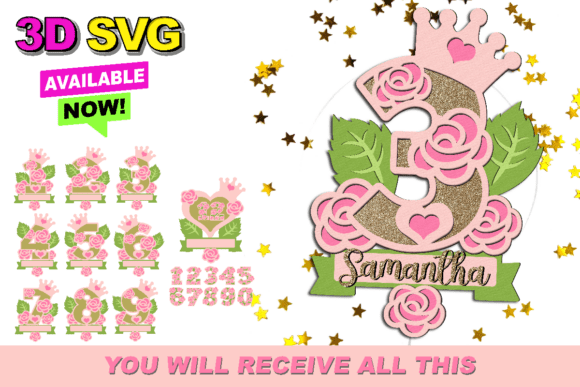
Roses Numbers Topper 3D SVG
A Designer’s First Look: Romantic, Refined, and Ready for Real Stitching
Opening Roses Numbers Topper 3D SVG feels like unboxing a small bouquet—delicate but intentional. The collection blends soft botanical curves with clean numeric forms, all rendered in that subtle 3D layering effect that lifts petals and numerals just enough to suggest depth without overwhelming the eye. It’s not hyper-realistic, nor is it cartoonish—it lands squarely in the sweet spot for handmade product appeal: elegant enough for a boutique baby onesie, warm enough for a custom embroidered tote bag, and distinctive enough to stand out in an Etsy search for personalized gifts.
Where This Design Truly Shines (and Where It Asks for Care)
I tested Roses Numbers Topper 3D SVG as the focal point on a linen-cotton tea towel—intended for a local kitchenware pop-up—and the result confirmed its strongest use cases. On medium-weight, stable fabrics like canvas, twill, or midweight cotton, the design holds its shape beautifully. The rose motifs integrate smoothly with the numbers, making it ideal for birthday embroidery, milestone baby items (think “1st Birthday” or “Baby Rose, 2024”), or even wedding date toppers on pillow covers or aprons.
It works especially well for custom apparel where personality matters more than precision: sweatshirt embroidery gains gentle charm, and tote bag designs feel curated—not mass-produced. For embroidered patch applications, the balanced proportions mean it stitches cleanly at 3–4 inches wide, and the layered look translates well into satin stitch gradients and controlled fill stitch transitions.
That said, Roses Numbers Topper 3D SVG isn’t built for every surface. On stretchy fabric like jersey or thin knits, the outer petal edges can blur unless stabilized heavily—so I’d avoid it on toddler t-shirts unless paired with cutaway stabilizer and reduced stitch density. Similarly, curved surfaces like caps demand careful placement: the topmost rose element tends to compress slightly under hoop pressure, so I recommend testing on a cap blank first and possibly simplifying one petal cluster if clarity suffers.
What Your Customers—and Your Brand—Will Actually Notice
Here’s what matters beyond stitch count: how the finished product makes someone *feel*. When a customer sees this on a nursery wall hanging or a holiday gift tag, they read “thoughtful,” not “downloaded.” That emotional resonance directly supports handmade product credibility and boosts perceived value. I’ve watched buyers linger longer on listings featuring this kind of cohesive, theme-driven digital embroidery file—especially when styled in natural light mockups.
For Etsy sellers and small shop products, Roses Numbers Topper 3D SVG strengthens brand consistency across seasonal collections. Pair it with muted thread palettes—dusty rose, sage, oatmeal—and it reads as part of a considered line, not a one-off graphic. And because the numbers are integrated (not tacked-on), it avoids the “clipart” trap that undermines trust in personalized gift offerings.
Practical Notes Every Embroidery Designer Should Check Before Stitching
- Test on scrap fabric first—especially if using textured weaves or dark backgrounds. What looks dimensional on screen may flatten on charcoal linen without contrast thread.
- Review stitch density in your embroidery software. Some versions of the 3D effect rely on overlapping satin stitch layers; too much overlap = puckering on lightweight cotton.
- Confirm hoop size compatibility. The full topper fits comfortably in a 5x7 hoop, but tighter placements (like on a child’s cap or narrow pillow border) may require cropping the outermost petals.
- Inspect small details at actual stitch scale—petal tips and number serifs can vanish if scaled below 2.5 inches without adjusting underlay or pull compensation.
- Use proper stabilizer: tear-away for stable wovens, cutaway for knits or high-pile fabrics like terry cloth towels.
- Check licensing before selling finished items or bundling as design assets. Since Roses Numbers Topper 3D SVG is marketed for commercial use, verify whether resale of physical goods or digital derivatives (e.g., printable mockups) is permitted.
Real-World Fit: Not Just Pretty Pixels, But Purpose-Built
Last week, I used Roses Numbers Topper 3D SVG to embroider a set of “2024” kitchen towels for a bridal shower gift. The client loved how the roses softened the formality of the year—making it feel celebratory, not corporate. No one asked, “Is this machine embroidery?” They just said, “It looks like something my grandmother would’ve stitched—but better.” That’s the quiet power of a well-balanced machine embroidery design: it bridges tradition and convenience without sacrificing warmth.
It’s equally effective for commercial embroidery shops producing small-batch boutique branding—say, stitching the “7” from the set onto aprons for a local bakery’s staff. The design scales predictably, layers cleanly in multi-step runs, and reads clearly even after repeated washing (provided appropriate thread and stabilizer choices are made).
Final Thought: A Quietly Confident Choice for Craft Business Owners
Roses Numbers Topper 3D SVG won’t shout—but it doesn’t need to. In a market flooded with overdesigned graphics and generic florals, its restraint is its strength. It supports storytelling (a baby’s first year, a couple’s anniversary, a shop’s founding date) without overshadowing the object it’s on. For creative entrepreneurs, apparel decorators, and digital product sellers, it’s less of a “design” and more of a reliable, emotionally intelligent tool—one that helps turn a simple embroidery project into a meaningful finished product.
If you’re curating design assets for a growing craft business, this belongs in your core collection—not as filler, but as a go-to for moments that deserve both beauty and intention.