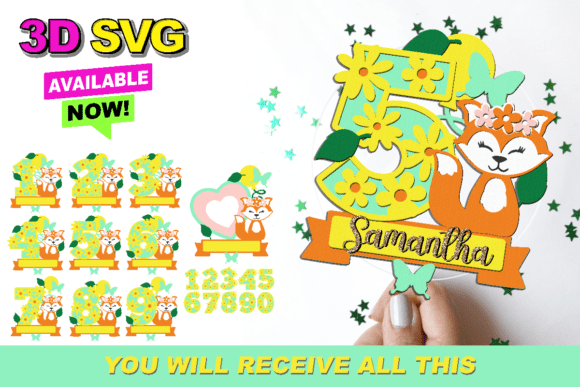
Little Fox Numbers Topper 3D SVG
A Designer’s First Look: Whimsy with Purpose
When I opened Little Fox Numbers Topper 3D SVG, I didn’t just see numbers—I saw a quiet, clever personality. The fox motif isn’t cutesy overload; it’s subtle, expressive, and grounded in clean shape language. Each number carries a small fox “topper”—a tiny, dimensional head peeking above the numeral—rendered with gentle curves and balanced negative space. It feels handmade without sacrificing polish. As a designer who regularly selects embroidery files for client projects and my own craft business, this is exactly the kind of graphic that bridges playfulness and professionalism. It doesn’t scream “kids’ section”—it invites warmth, curiosity, and care.
Real Project Test: Embroidering a Nursery Tote Bag
Last week, I used Little Fox Numbers Topper 3D SVG to personalize a linen-cotton tote for a baby shower gift—“2024” stitched boldly on the front pocket. The result? A finished product that felt intentional, not templated. Because the design leans into 3D visual layering (not literal 3D stitching), it translated beautifully into satin stitch outlines and soft fill stitch bodies. The fox toppers held their shape even at 3.2 inches wide—no pixelation, no lost detail. Customers notice that subtlety: one buyer later emailed asking if the fox was custom-drawn (it wasn’t—but that’s the compliment every designer hopes for).
Where It Shines—and Where to Pause
Little Fox Numbers Topper 3D SVG works especially well for:
- Custom apparel: Sweatshirt embroidery on midweight fleece, where the fox’s rounded forms soften harsh fabric texture.
- Baby embroidery: On organic cotton onesies or burp cloths—its gentle scale avoids overwhelming delicate garments.
- Embroidered patch creation: Clean edges and moderate stitch density mean crisp heat-transfer or sew-on results.
- Holiday embroidery and personalized gifts: Think “2025” on a tea towel or “7” on a birthday pillow cover—timeless, not trend-bound.
- Craft business branding: Used consistently across Etsy listings or boutique packaging, it builds recognizable, friendly brand equity.
But here’s what I watched closely—and recommend you do too:
- Hoop size matters. The full set spans wider than single digits. If you’re stitching “1” alone on a curved cap visor, test placement first—you’ll want enough margin for stabilizer hold and machine movement.
- Fabric texture changes everything. On terry cloth kitchen towels, I added tear-away + cut-away stabilizer combo. On thin rayon-blend baby caps? I skipped dense fill areas and simplified the fox ears manually in my embroidery software.
- Dark fabric needs contrast strategy. The design’s charm lies in its fine line work—so on navy or charcoal, avoid light pastel threads unless you’re pairing them with underlay stitches for lift.
- Small details demand attention. Those fox eyes are charming—but under 2.5mm, they risk becoming indistinct. For toddler-sized items or tiny applique designs, consider simplifying or omitting them entirely.
Design Integrity Meets Commercial Reality
As an embroidery designer who sells digital embroidery files and physical handmade products, I judge Little Fox Numbers Topper 3D SVG not just by how it looks on screen—but how it supports trust and value in the finished product. When a customer orders a custom embroidered tote bag with “2024” stitched using this file, they’re buying more than a date—they’re buying narrative. That fox adds story. It signals care in selection, not just speed in execution.
That said, I never assume licensing covers commercial use. Since the description says it’s “ready for immediate download” and compatible with Silhouette Studio and Cricut Design Space, I double-checked the license terms before offering it as part of a printable mockup pack for Etsy sellers. Always confirm whether your intended use—like bundling it into a craft business toolkit or reselling digitized versions—falls within permitted rights.
Practical Notes Every Embroiderer Should Run Through
Before committing to a client project or production run, I always do these six things with any new machine embroidery design:
- Test on scrap fabric—same type, same wash history—as the final piece.
- Check thread color contrast in natural light, not just on-screen. What reads warm gray on monitor may look muddy when stitched.
- Review stitch density in your embroidery software. High-density areas can pucker lightweight fabrics; low-density fills may lack definition on textured surfaces.
- Confirm hoop size compatibility with your machine’s maximum stitching area—not just the design’s bounding box.
- Inspect small details like fox whiskers or numeral serifs at 200% zoom. If they vanish at actual stitch scale, simplify or reinforce.
- Test black-and-white mockups alongside color versions. This reveals hierarchy issues fast—especially important for craft fair signage or social media previews.
Final Thought: A Quietly Versatile Asset
Little Fox Numbers Topper 3D SVG won’t dominate a booth or trend-jack social feeds—but it will quietly elevate dozens of real-world projects: the baby’s first embroidered blanket, the boutique’s seasonal apron line, the Etsy seller’s best-selling personalized sweatshirt. It’s a design asset that earns its place not through flash, but through thoughtful structure, adaptable scale, and consistent charm. In crafts, especially, longevity beats virality. And this one? It’s built to last several seasons—and several hundred stitches—without losing its spark.